
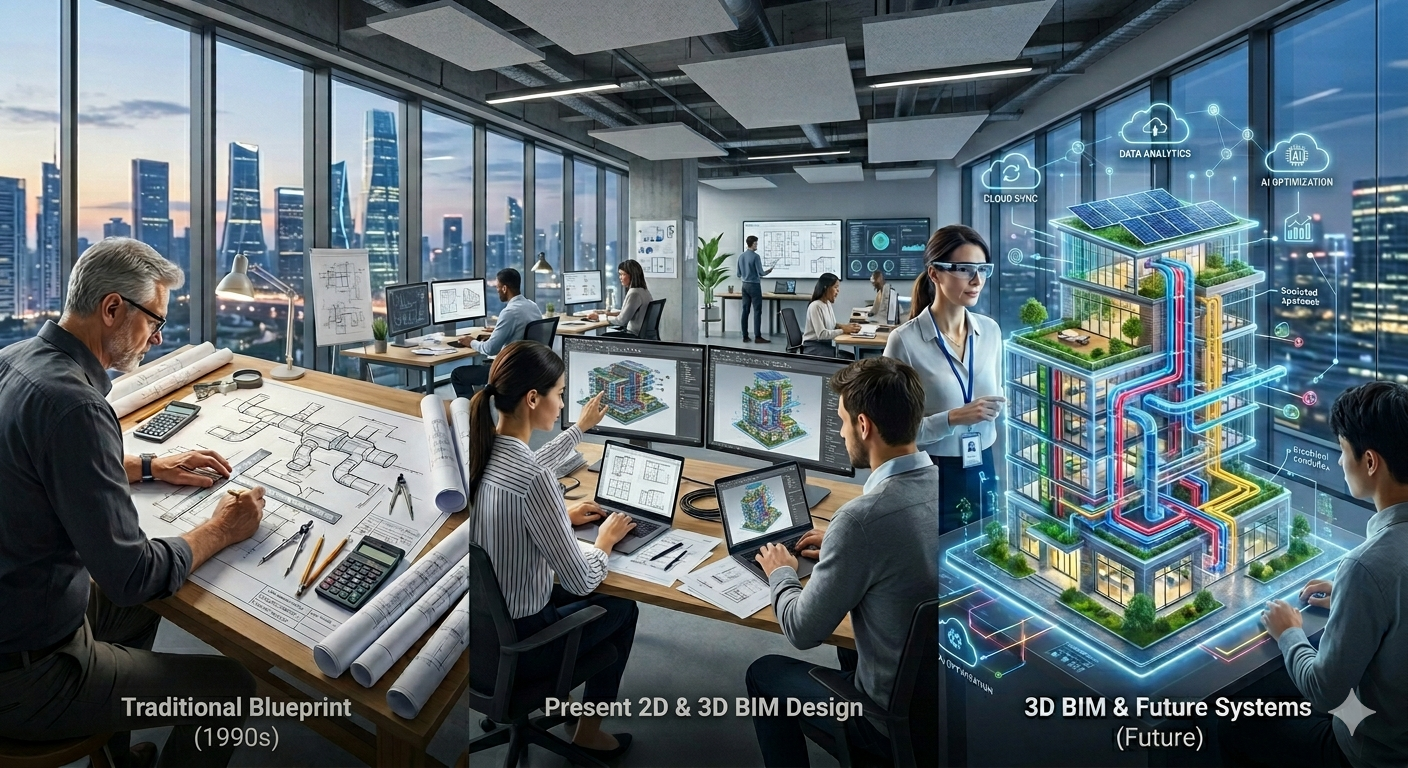
Mechanical design in the building industry has come a long way. Not so long ago, engineers spent countless hours meticulously drafting HVAC, plumbing, and MEP systems on blueprints—carefully measuring every line and connection. Mistakes were costly, revisions tedious, and collaboration across teams a real challenge. Complex projects, such as hospitals, high-rise towers, and commercial complexes, demanded patience, precision, and deep technical expertise.
Fast forward to 2026, and mechanical design has been completely transformed. Today, software like AutoCAD, Revit, and advanced BIM platforms are no longer just tools—they are intelligent, collaborative, and data-driven systems that allow engineers to design, analyze, and optimize complex mechanical systems efficiently.
At Cardinal Engineering Consultant, over 95% of our projects are based in the USA, giving us extensive exposure to American building codes, green standards, and construction practices. Staying updated with the latest software, providing continuous employee training, and fostering a culture of innovation are key pillars of our success.
From Blueprints to Digital Drafts
The transition from paper to digital design started with 2D CAD software like AutoCAD. Engineers could now:
- Digitize blueprints
- Make revisions quickly
- Share drawings efficiently across multiple teams
While this was a major improvement, 2D drafting still had limitations. Designs remained flat, and coordinating complex mechanical, electrical, and plumbing systems often required extra effort. For large-scale US projects, especially those adhering to stringent codes like ASHRAE, NFPA, and LEED, more advanced, integrated solutions were necessary.
Seeing the Whole System: 3D Modeling
The introduction of 3D modeling in Revit revolutionized how engineers approach mechanical design. Engineers can now:
- Build fully interactive, realistic models
- Detect clashes and conflicts before construction
- Coordinate seamlessly with architects, contractors, and project managers
For US-based projects, this capability is critical. It ensures compliance with local codes, accelerates approvals, and allows clients to visualize systems clearly streamlining construction planning and minimizing costly on-site errors.
Smarter Design with AI and Automation
In 2026, artificial intelligence and automation are transforming mechanical design workflows. Modern software can:
- Optimize HVAC and MEP layouts automatically
- Perform accurate load calculations and energy simulations
- Suggest energy-efficient solutions that comply with US standards
At Cardinal Engineering Consultant, every engineer is trained on these advanced tools. By automating repetitive tasks, our teams focus on innovation and problem-solving, delivering faster, smarter, and code-compliant solutions to our clients in the USA.
Connected and Collaborative: Cloud Engineering
Cloud-based platforms have redefined teamwork in mechanical design. Engineers can now work remotely and in real time, updating designs and collaborating seamlessly with global and local teams.
For US projects, this provides clear advantages:
- Faster approvals and feedback loops
- Enhanced coordination across multiple stakeholders
- Timely project delivery without compromising quality
Cloud collaboration ensures that Cardinal Engineering Consultant projects, regardless of size or complexity, remain precise, efficient, and fully aligned with client expectations.
Sustainable Design: Energy Efficiency at the Core
Modern mechanical design goes beyond precision—it emphasizes sustainability. Engineers now have tools to:
- Simulate building energy usage
- Optimize HVAC and MEP systems
- Comply with US energy codes and green building standards (LEED, ASHRAE, IECC)
At Cardinal Engineering Consultant, sustainability is embedded in every project. By designing energy-efficient, environmentally responsible systems, we help clients reduce operational costs while meeting modern US green building expectations.
Continuous Learning: Staying Ahead of Innovation
Technology evolves rapidly, and staying ahead is essential. At Cardinal Engineering Consultant, our training programs cover:
- The latest software updates and BIM innovations
- AI-driven design tools and automation
- US code compliance and sustainable design strategies
This culture of continuous learning allows us to consistently deliver high-quality, innovative, and future-ready designs for our USA-based projects.
Building the Future: Precision, Innovation, and Excellence
From painstaking blueprints to intelligent, AI-powered BIM systems, the evolution of mechanical design software represents a transformation in how engineers think, collaborate, and deliver results.
With deep expertise in US building codes, energy standards, and construction practices, Cardinal Engineering Consultant provides high-performance, sustainable, and precise MEP designs for projects across the country. The journey from blueprints to smart BIM has revolutionized building engineering—and we’re proud to lead the way.
📩 Contact us: [email protected]
🌐 Website: www.cardinaleco.com